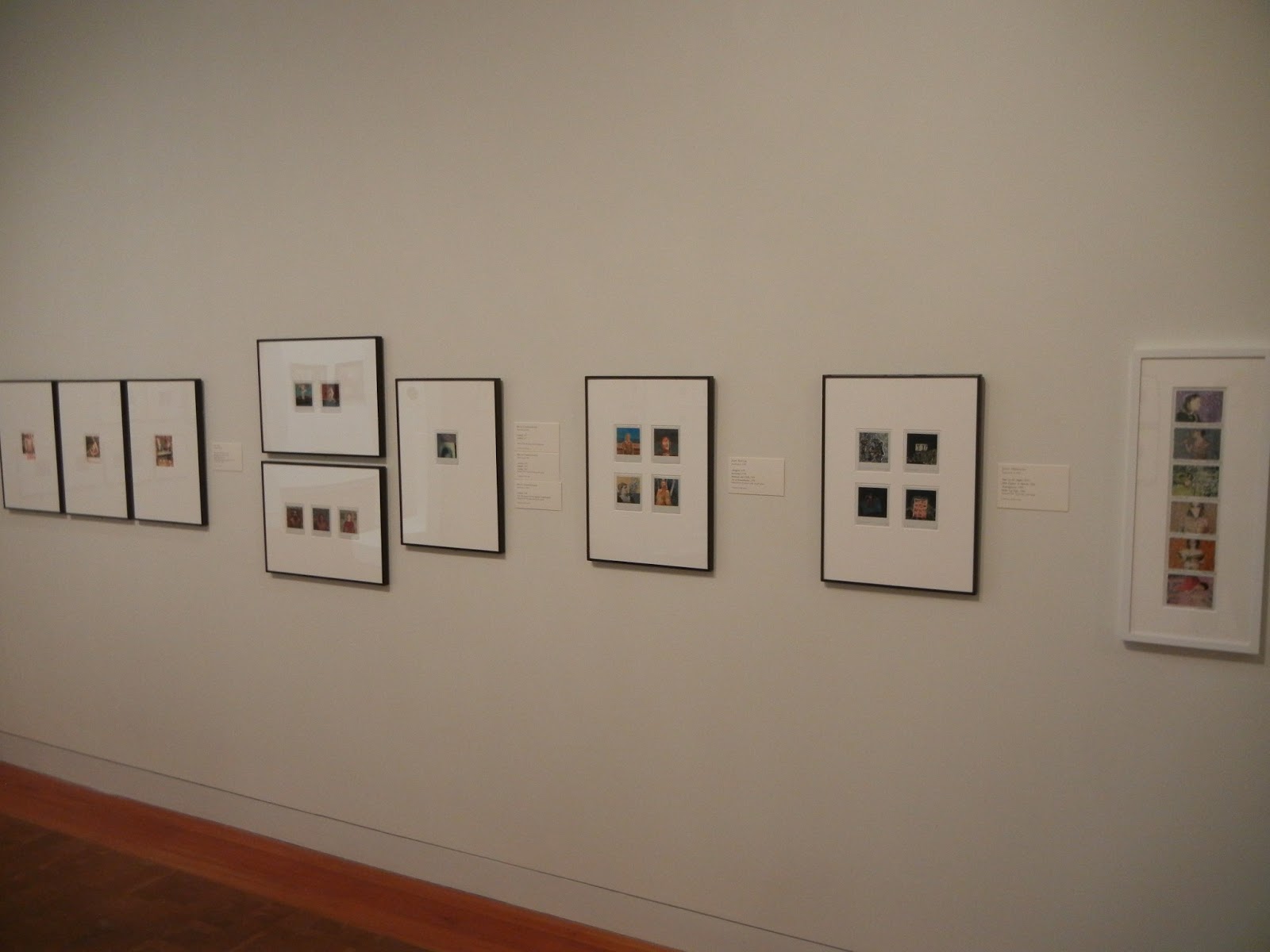
 JTF (just the facts): A group show of 41 artists/photographers, variously framed and matted, and hung against white walls in a series of four dimly lit rooms on the first floor of the museum and in one small gallery on the second floor. The works use a variety of Polaroid processes and were made between 1969 and 2013; nearly all of the works on view are unique. Physical sizes range from roughly 4x3 to 77x62 (multiple images). A catalog of the exhibit was recently published by Delmonico Books/Prestel (here) and is available in the bookshop for $50. (Installation shots at right.)
The following artists/photographers have been included in the show, with numbers of works on view, print details and dates as reference:
- Ansel Adams: 4 SX-70 prints, 1972
- Jack Butler: 5 SX-70 prints, 1978
- Ellen Carey: 1 set of 6 Polacolor Type 108 prints with nail polish, 1977, 1 large format Polaroid ER print, 1994, 1 large format Polaroid print, 2003
- Carter: 8 Polaroid prints (4 diptychs), 1970-2007, 2 Polaroid prints, 2005 (in glass case)
- Bruce Charlesworth: 6 SX-70 prints with acrylic paint (1 triptych, 1 diptych, 1 single image), 1977-1980
- Chuck Close: 1 set of large format Polacolor prints, 1979, 1 set of 9 dye diffusion transfer prints, 1979, 1 large format Polacolor print, 1980
- Anne Collier: 5 Polaroid prints, 2004
 Laura Cooper/Nick Taggart: 1 set of 120 Polaroid Type 667 prints, 1993-2013
- John Coplans: 1 three paneled frieze of 9 Type 55 prints, 1997, 1 set of 5 dye diffusion transfer prints, 1986
- Marie Cosindas: 2 dye diffusion transfer prints, 1966
- Philip-Lorca diCorcia: 9 Polaroids, n.d.
- Charles and Ray Eames: 1 color film, 1972
- Walker Evans: 8 SX-70 prints, 1973/1974 (in glass case), 1 SX-70 camera (in glass case)
- Bryan Graf: 9 Polaroid Type 600 prints, 2008-2013, 1 Polaroid print and 1 black and white Fiber print, 2010
- Richard Hamilton: 4 artist's books with Polaroid plates, 1968-2001 (in glass case)
- Robert Heinecken: 8 SX-70 prints with offset lithography, 1979 (in glass case), 5 large format Polacolor prints, 1983
- David Hockney: 2 composites of SX-70 prints, 1982
- Barabara Kasten: 1 large format Polacolor print, 1982
- Andre Kertesz: 4 SX-70 prints, 1979/1984
- Les Krims: 3 archival pigment prints from SX-70 prints, 1974/later
- David Levinthal: 1 large format Polacolor ER Land print, 1990, 4 SX-70 prints, 1983-1985
- Miranda Lichtenstein: 5 Polaroid prints, 2002-2005
- John Maggiotto: 8 SX-70 prints, 1983
- Andreas Mahl: 1 SX-70 emulsion transfers with hand coloring, 1981/1984
- Robert Mapplethorpe: 4 Polaroid prints (1 diptych, 2 single images), 1972-1974
- Joyce Niemanas: 4 SX-70 prints with paint, 1979-1980, 1 montage of SX-70 prints, 1981
 Catherine Opie: 14 Type 600 prints (1 set of 9, 1 set of 4, 1 single image), 2004
- Lisa Oppenheim: 5 c-prints, 2008
- Beatrice Pediconi: 6 Polaroid prints, 2009-2011
- Victor Raphael: 1 Polaroid 600 print with acrylic, 1985, 3 Polaroid Spectra prints with metal leaf, 1990-1997
- John Reuter: 4 SX-70 prints with acrylic paint, 1978
- Lucas Samaras: 7 SX-70 prints, 1973/1974, 3 dye diffusion transfer prints with applied color, 1970/1971, 1 collage of Polaroid type 808 prints, 1984
- Dash Snow: 2 Polaroid prints with masking tape and paint, n.d., 11 SX-70 Prints, n.d. (in glass case)
- Paul Thek: 3 Polacolor prints, 1969 (in glass case)
- Mungo Thomson: 10 Polaroid Type 600 prints, and 1 cartridge card, 2009
- Andy Warhol: 3 Polacolor Type 108 prints, 1977, 3 Polacolor 2 prints, 1981, 2 Polacolor prints, 1981-1982/1986
- William Wegman: 2 large format Polacolor prints, 2005
- James Welling: 4 chromogenic prints from original Polaroids, 1975/1976
- Grant Worth: 4 Polaroid Type 600 prints, 2006
- Grant Worth/Micki Pellerano: 2 Impossible Project Fade to Black prints, 2010
- Grant Worth/Mark Spalding: 4 Type 600 Wild Sides prints, 2005 (in glass case)
 Comments/Context: The long sweep of photographic history can in many ways be boiled down to a never ending series of experiments with processes and materials for image making; technology has never been very far from the center of the medium. From the daguerreotype to the digital file, artists have continually embraced new technical innovations, only to immediately try to break them, defining their strengths and weaknesses and testing their limits. In each case, the question of "what is it good for" has been explored with relentless imagination. This show follows the winding path of Polaroid, from its hand held SX-70 instant camera to its massive large format cameras and films, tracing singular experiments by a variety of artists across nearly four decades. The exhibit doesn't try to be a comprehensive history of the company, its inventions, or the best artworks made by its many users, but instead offers a tight sampler of how artists' have pushed and pulled at the constraints of the Polaroid technologies and exploited the specific properties of its many photographic processes.
Starting in the early 1970s, he develop before your eyes process of the SX-70 was a major source of creative destruction for a wide range of artists. After the prints were ejected from the camera, they were subjected to a dizzying array of manipulations, breaking down the chemistries in unintended ways to create expressionistic gestures and chance-driven alterations. Lucas Samaras transformed nude self-portraits into swirling, melting body parts, while John Reuter cooked his prints and then split them apart to add paint inside the sandwich. Les Krims poked and prodded, while Bruce Charlesworth erased and over painted; Victor Raphael added metal leaf, while Dash Snow experimented with burning - the SX-70 encouraged a flourishing of active modification, both in the past and more recently.
 The immediacy of the small square format image of SX-70 was also a compositional challenge for many photographers. Recognized masters like Ansel Adams, Walker Evans, and Andre Kertesz, embraced the SX-70 and found ways to make pictures in their own styles within its limitations. Others (like Philip-Lorca diCorcia and Andy Warhol) used the camera for test shots and intermediate images that later became the raw material for finished artworks. David Hockney and Joyce Neimanas took hundreds of prints and collaged them into jittering, multi-perspective mosaics. And both Robert Heinecken and Catherine Opie pointed the camera at the television, fitting fragments of the screen into the tiny frame.
At the other end of the size spectrum, Polaroid's large format cameras opened up new avenues for experimentation with photographic scale. Chuck Close's massive self portraits are perhaps the most well known example of this explosion in size (and there are several big faces on view here), but many other artists also embraced the precision of the 24x20 camera. Solid examples from David Levinthal, William Wegman, and Barbara Kasten point to a diversity of styles and approaches, and Ellen Carey took the issue to its extreme with her Pull series, where monumental 40x80 emulsions are stretched and elongated into surfboard like abstract forms.
 Interspersed among these larger themes are surprising one-offs and unexpected twists: frozen prints, photographs of photographs, sexy bodies and porn, overpainted nail polish, silky emulsion transfers, experiment after experiment. While not every work in this show is entirely memorable, there is something invigorating about such a blossoming of trial and error. Artists of all shapes and sizes took the Polaroid processes through their paces and did things the inventors would never have dreamed were possible. The show is an insightful reminder that deliberately exceeding the posted limits and purposely getting it exactly wrong can often be the road to something new and original.
Collector's POV: Given this is both a diverse group show with many artists' work on view and an exhibit taking place in a museum venue (thereby no posted prices), a discussion of specific prices and secondary market history will be omitted for this review.
 Rating: ** (two stars) VERY GOOD (rating system described here)
Transit Hub:
- Features/Reviews: New York Times (here), Wall Street Journal (here), Economist (here), PetaPixel (here)
Through June 30th
124 Raymond Avenue
Poughkeepsie, NY 12604


